
Inside Monroe County Property Tax Records
Monroe County property tax records pull from two county sources. The assessor's parcel card holds characteristics and value. The treasurer's LOW Tax Info carries the bill and payment history. Indiana assesses at Market Value in Use, with annual adjustments drawn from neighborhood sales and trends, so the bill reflects the taxable amount, rates, and deductions for its pay year.
| Field | What It Shows | Where |
|---|---|---|
| Land, improvement, total value | Components and total assigned to the parcel | Assessor parcel card |
| Assessment year | Date label for the value | Assessor |
| Deductions and taxable amount | Adjustments before the bill is calculated | Auditor and assessment records |
| Bill and payments | Amounts charged, due, or posted | Treasurer LOW Tax Info |
| Duplicate number | Tax-bill routing key | Treasurer |
Assessed value is not an appraisal. Nor does it promise a sale price. Treat the latest-sale field as a dated clue, since it may reflect an old transaction or one that needs deed review before you rely on it.
Three Monroe Offices Split the Work
Monroe County Assessor keeps the parcel details and assessed values. The Treasurer takes tax-bill and payment questions. The Auditor runs deductions, rates, liens, and the county tax sale. Ask the right office and you save time.
The Assessor works from 100 W Kirkwood Avenue. It is reachable at 812-349-2502 on weekdays from 8 a.m. to 4 p.m. The Treasurer, at 812-349-2530, can confirm an online balance, payoff, or recent payment. An APRA request may reach eligible county administrative records. It cannot move a filing deadline or open a protected file, though.
LOW Tax Info Searches Monroe Bills
No registration is needed for the LOW Tax Info service. Searches run by owner name, property address, state parcel number, or duplicate number. Results cover property details, a year selector, and pay-year history back to 2016. County software feeds the data. Updates land nightly.
| Search choice | Use | Check before relying |
|---|---|---|
| Owner name | Find bills linked to a roll party | Name variations and parcel match |
| Property address | Open one known site | Mailing city and street form |
| State parcel number | Match the assessment parcel | Punctuation and all digits |
| Duplicate number | Retrieve a tax account | Correct pay year |
One quirk affects printouts. Choosing a prior year does not change it. The bill icon prints the current bill anyway, so note the on-screen year when researching history; the official LOW Tax Info instructions page spells this out.
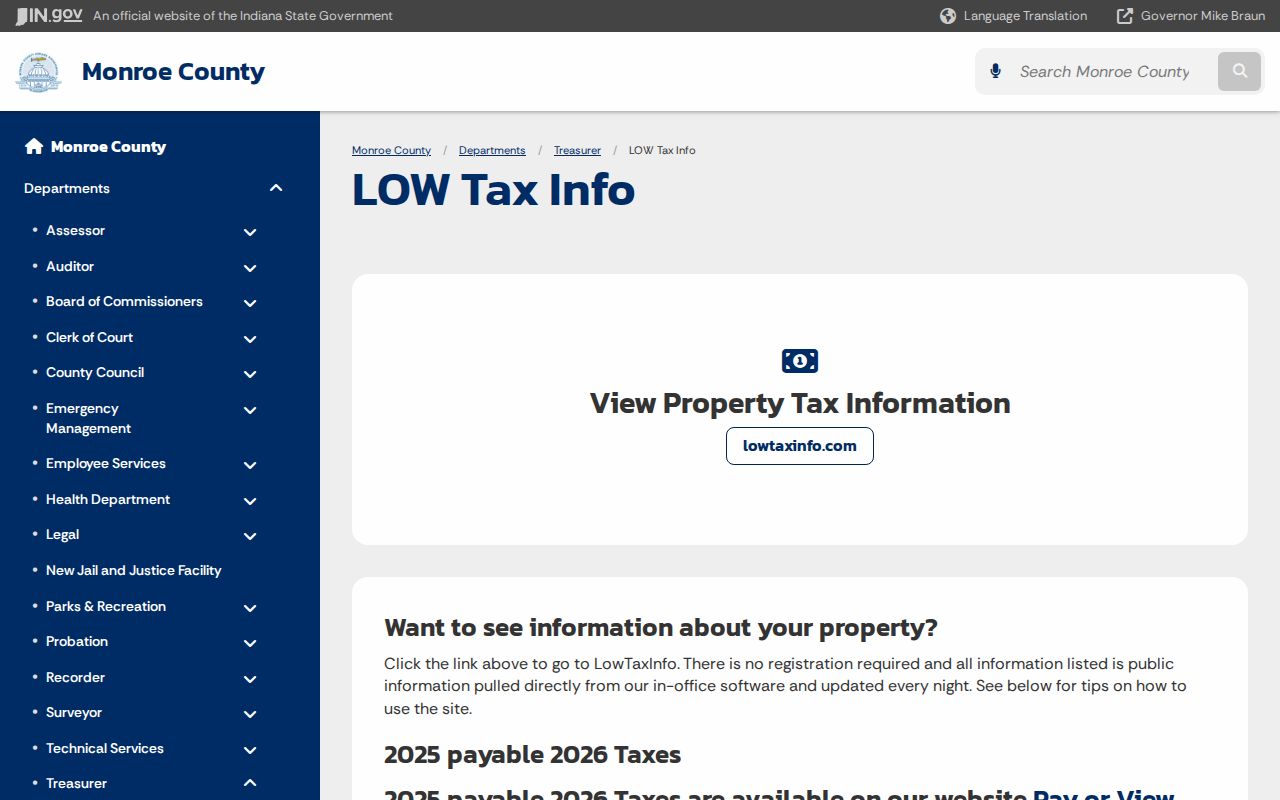
The page confirms the no-registration search route. It also flags the gap between the selected year and the printed current bill.
Look Up a Monroe County Tax Bill
Start with the address when no parcel key is known. Confirm the situs and owner. Then save the state parcel number and duplicate number, and use the year selector to separate the assessment year from the later pay year.
- Search LOW Tax Info by address, owner, PIN, or duplicate number.
- Open property details and select the intended pay year.
- Compare assessed and taxable amounts with the Assessor's dated parcel card.
- Ask the Treasurer to confirm a recent payment or payoff that appears stale.
- Assessed value
- The value assigned under Indiana's Market Value in Use system.
- Taxable amount
- The amount left after applicable deductions.
- Levy or rate
- The local rate applied within the parcel's taxing district.
- Tax lien
- A claim arising from unpaid property tax.
Monroe Values Adjust Each Year
Indiana once reassessed property on a ten-year cycle. That model is gone. Monroe County now compares prior values with current neighborhood sales and trends them toward Market Value in Use. January 1 is the annual assessment date. Bills are generally due May 10 and November 10. Always record the assessment year, because a 2026 parcel value, an older sale disclosure, and a 2025 pay-year line can all sit in one trail without describing the same moment. The general Monroe County property value explanation separates assessed, market, and recorded-sale figures.
Deductions Change Monroe Taxable Amounts
Deductions cut taxable value. Each carries its own eligibility and filing rules. County materials point applicants to the linked Form 136 instructions and Auditor channels. Do not infer a deduction from a low bill. Never assume a prior owner's deduction follows a transfer. Compare the assessed value, deduction entries, taxable amount, district, and pay year side by side. If a deduction is missing, ask the Auditor or Assessor which form and year controls. A parcel card can show value fields. The bill shows the result after tax routing. Note: A tax bill reflects the deductions posted for its cycle, not every pending application.
Monroe Delinquency and Tax Sale
Delinquency can push a parcel toward tax sale. A list entry is only an eligibility and notice record, though. The Monroe County Auditor tax-sale page schedules the 2026 online Zeus auction for October 7, 2026. Minimum bids, redemption, and no-warranty limits are described too. Before bidding, confirm the parcel number, legal description, minimum bid, redemption status, court petition, and any later recorded tax deed. Addresses, legal descriptions, and key numbers carry no warranty. A list entry does not itself show transferred title.
Appeal a Monroe County Assessment
The Assessor's appeal instructions use Form 130. Strong appeals tie evidence to the assessment date. Before filing, check square footage, land acreage, class, neighborhood, sales, condition, and any factual error in the parcel record.
Appeal dates change by year. Bloomington's 2026 Form 11 notices were mailed April 28 and carried a June 15, 2026 deadline; verify the current notice before filing.
The official appeal page lays out the Form 130 steps.
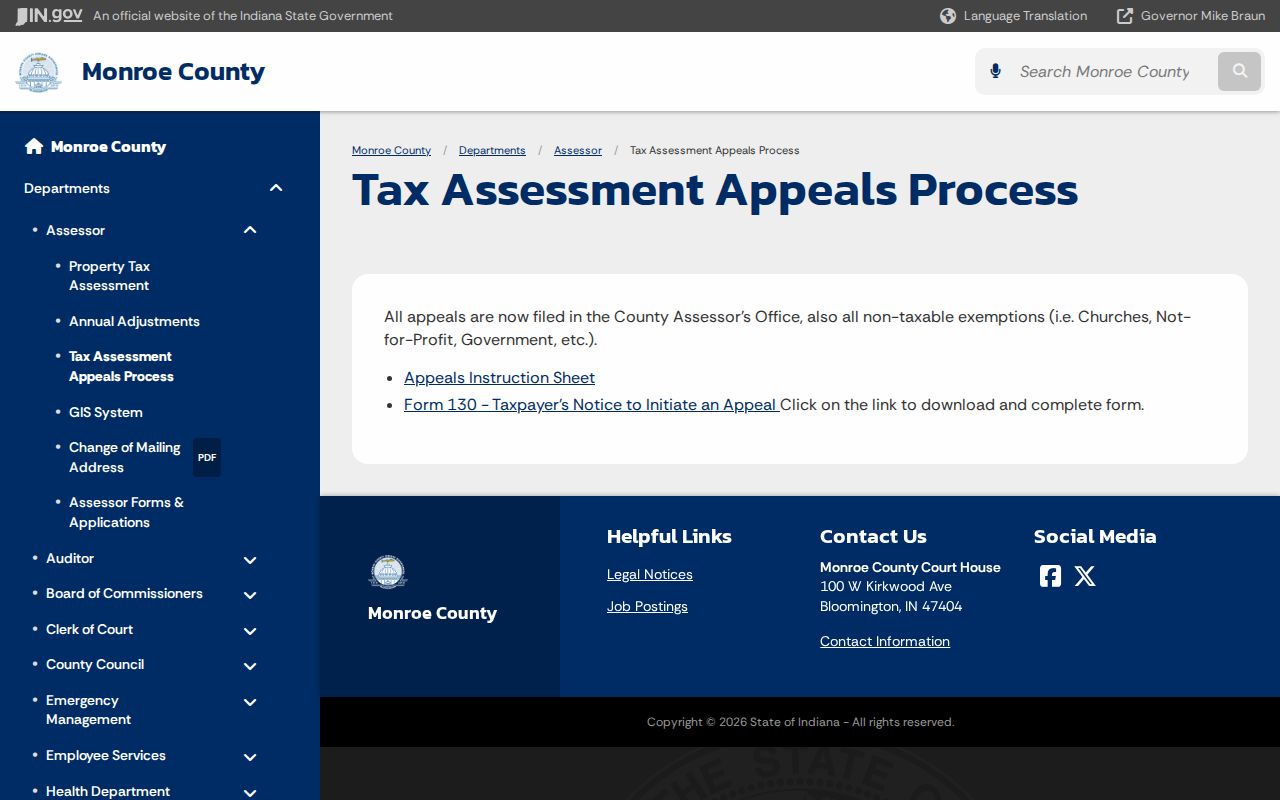
The Assessor's office handles the appeal form itself. Bill payments and current balances belong to the Treasurer. An appeal targets the assessed value or the facts behind it, never the tax rate. Evidence should fit the valuation date and the parcel. Useful support includes corrected measurements, photographs of condition, and recent sales that truly compare. An appraisal with a relevant date helps. So does proof that the property class or land details are simply wrong. Monroe County's annual-adjustment method relies on neighborhood sales. A sale from a distant market or an unlike property may carry little weight.
Read the Form 11 notice before trusting any web result. That notice states the value and the appeal timing for its cycle. Monroe's 2026 mailing and deadline are dated facts, not standing dates for later years. Keep copies of the form, your evidence, and the filing receipt. Keep any conference or board decision too. Missing the window can leave the posted value in place for the whole cycle.
Older or corrected data may need direct office help. Ask the Assessor for a staff-assisted parcel card. Or ask the Treasurer for a bill and payment explanation. Name the PIN, duplicate number, owner, property address, and year. Exemption and deduction questions go to the Auditor, with the form and filing year identified. For administrative material that is not online, a focused request under Indiana's Access to Public Records Act can state the parcel, record type, and date span. It can also name a preferred delivery.
Never mix title conclusions with tax conclusions. A bill may still show a prior roll owner after a deed records. Payment by one person conveys no land. A tax-sale list is not a completed sale. When land status matters, match the newest deed at the Recorder. Then match the parcel at the Assessor, the payment at the Treasurer, and any court step in MyCase.