
Trace Monroe County Former Owners
A backward deed chain works from the newest known grantee toward each earlier grantor. Monroe County's record sources span very different eras. The method changes at the online cutoff. For every link, keep the instrument reference, recording date, party roles, and legal description.
| Transfer point | Time span | Repository | Ownership clue |
|---|---|---|---|
| Doxpop deed index | January 1991 to present online | Monroe Recorder and Doxpop | Grantor, grantee, date, and instrument |
| Deed books and microfilm | Before the online window | Recorder counter and archive | Older conveyances and book/page links |
| Early party indexes | 1811 to 1870 runs identified | Indiana State Library guide | Grantor and grantee references |
| Maps and plat books | 1856 to 2011 runs identified | State Library, Surveyor, local repositories | Lot, subdivision, and owner-map context |
Doxpop handles the most recent transfer. Deed books take over before January 1991. Maps and directories are clues only, supporting a search without ever replacing the recorded transfer itself.
Monroe's January 1991 Divide
Monroe document viewing starts in January 1991, according to the Recorder's online-access page. Doxpop grants residents six free searches each month. Business use requires a subscription. The cutoff is about delivery, not record age. Former owners from earlier decades remain in deed books, staff indexes, and archival microfilm.
The Doxpop recorder search opens the modern end of the former-owner trail.
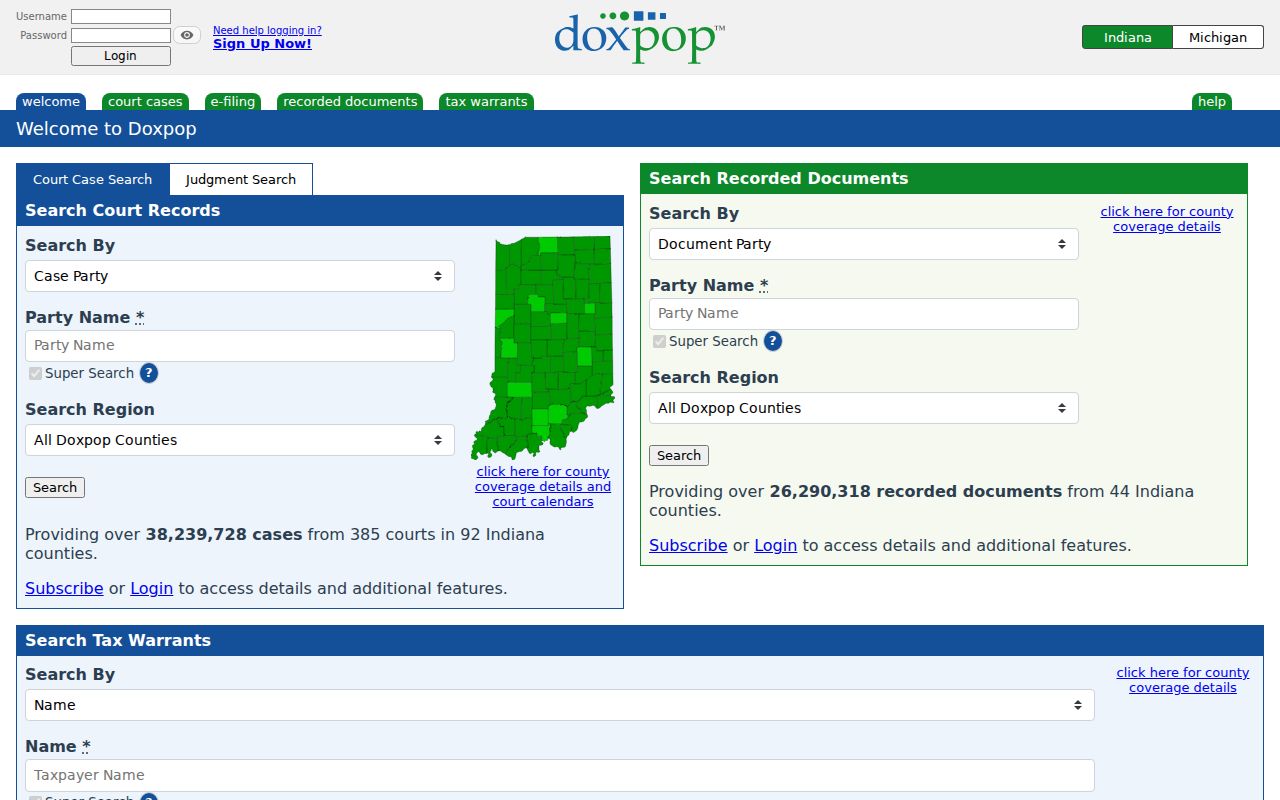
The search shell covers the modern stretch. Deed books carry the chain past that edge. When an older item is missing, contact the Recorder at 100 W Kirkwood Avenue, Room 122, Bloomington, by phone at 812-349-2520 or email at recorder@co.monroe.in.us. Give staff the legal description and any last known book and page clue.
Older chain. The online image window starts in January 1991; earlier ownership must continue through Recorder books, microfilm, and historic indexes.
Reconstruct Monroe's Deed Chain
Match the same parcel at every step. Names alone can join unrelated people, and street addresses may be new. Use the legal description as the thread. Lot, subdivision, section, range, and instrument references tie each link to one parcel.
- Find the newest deed in Doxpop with the current owner as grantee.
- Record that deed's grantor, date, instrument or book/page, and legal description.
- Search the grantor as an earlier grantee and verify the same tract.
- Repeat until January 1991, then continue with Recorder staff indexes and books.
- Grantor
- The party conveying the stated interest.
- Grantee
- The party receiving that interest.
- Reverse index
- An index organized by grantee, useful for finding how an owner acquired land.
- Chain of title
- The linked sequence of instruments affecting the same land.
- Quitclaim and warranty deed
- Different deed forms whose legal effect must be read from the full instrument.
Plats Keep Monroe Lots Aligned
A street address can change while a lot-and-block description survives. Official county parcel fields still list subdivision, plat map, lot, section, and range. Recorded plats sit with the Recorder. The Surveyor adds PLSS monument records and the 1926 plat maps. Reach for these references whenever a tract was split, replatted, or folded into a later subdivision.
The State Library Monroe map collection spans map and plat-book material from 1856 through 2011. Its 1920 owner map is a standout. So is the 1925 to 1941 plat-book run. Together they can bridge a historic name to a modern parcel.
Probate Interrupts a Name Chain
A deceased owner leaves more than one record behind. MyCase may show an estate, a personal representative, or an order. The Recorder may hold the executor deed, administrator deed, affidavit, or a later transfer. Search the decedent, the estate name, and the representative. Then return to the Recorder. See which instrument entered the public land chain.
Trusts and joint tenancies can also make the sequence look incomplete. The public deed may name a trustee or a surviving party. Not everyone with a private interest appears on it. Record what the instrument says without inferring beneficiaries.
Monroe Libraries Add Human Clues
Libraries add the human clues that deed indexes lack. The MCPL Indiana Room, the Monroe County History Center, and the Indiana State Library hold city directories, newspapers, and obituaries. They also keep maps and local histories. These help when a deed index spelling is unclear. They also help when a street was described differently decades ago.
Always carry each clue back to a primary county record. Note the source year. Note whether it is an index, map, abstract, or image. A directory shows who lived at an address that year, not necessarily who held title.
No Verified Monroe Fire Gap
No authoritative account documents a courthouse fire that destroyed a defined run of Monroe land records. Treat that familiar story with doubt. Before blaming a gap, check corrective or re-recorded deeds, probate transfers, predecessor indexes, staff indexes, microfilm, and alternate spellings.
Monroe County was formed in 1818 from Orange County. Early references can predate the county itself. The State Library's 1811 to 1870 grantor and grantee index runs may therefore point into predecessor-era material.
Log Each Monroe Transfer
A simple log guards against false links among former owners. Give each row a transfer date. Add the grantor-to-grantee path and deed type. Include the instrument or book and page. Add a short legal-description check too. Note any lot split, probate filing, trust, or corrective deed that changes the sequence.
Never infer ownership from a tax list, directory, or map alone. Those sources narrow a date and a name. The recorded instrument is the link to preserve. For one instrument's mechanics and copy fees, see the county's Monroe deed records page.
Follow Monroe Legal Descriptions
Test every transfer against the land itself, not just a surname that looks right. Start with the current parcel card. Copy the subdivision, lot, section, range, acreage, and plat references from it. Then watch how each older deed words the tract. A partial lot, an excepted strip, a replat, or a combined parcel can shift the language while the link to the prior conveyance stays intact.
Monroe County's official parcel fields cover the legal description, subdivision, plat map, lot, section, range, political township, and legal acreage. Treat them as finding aids. When the chain turns on exact land, the recorded deed and plat are what you read. GIS geometry is only approximate. It cannot prove an older tract matches a modern outline.
Address history is less stable. A rural route can gain a house number, a road label can change, and a mailing city can differ from the incorporated jurisdiction. Begin with the address. Then let the legal description carry the chain backward.
Compare Monroe Deed Types
A warranty deed, quitclaim deed, personal-representative deed, corrective deed, or trust transfer can each occupy a link in the prior-owner chain. That chain sits inside Monroe County property records. The form name alone does not state the full interest conveyed. Read the granting language instead. The parties, execution and recording dates, and land description in the deed records tell you what actually changed hands.
Mortgages, releases, liens, plats, and powers of attorney may share names with a deed search. They add context around a parcel. But they do not automatically create a former owner of record. Weigh them as supporting documents rather than links in the chain.
Depth of Monroe Ownership Records
Almost any deed form can occupy a link in a Monroe County prior-owner chain. Warranty deeds, quitclaim deeds, personal-representative deeds, corrective deeds, and trust transfers all appear among the recorder's deed records. The form name alone never states the full interest conveyed. Read the granting language, the parties, the execution and recording dates, and the land description. Draw conclusions only after that. Mortgages, releases, liens, plats, and powers of attorney often share names with deeds in a property search. But they only add context. They do not by themselves create a former owner.
Lawful history. Use former-owner records for house history, estate work, and property diligence. Never use them to track, harass, or harm a living person.