
Monroe County Deed Records Explained
The Monroe County Recorder keeps deeds, mortgages, real-estate contracts, subdivision plats, surveys, liens, releases, powers of attorney, and bonds on permanent record. Each filing shows what entered the public land record, who signed it, and which legal description it touches. A recorded deed cannot guarantee that no unrecorded claim exists somewhere in the chain.
| Deed Type | What It Does | Common Use |
|---|---|---|
| Warranty deed | Conveys land with stated title promises | Ordinary sale or transfer |
| Quitclaim deed | Conveys the interest the grantor holds | Correcting or simplifying an interest |
| Personal representative deed | Transfers land under estate authority | Probate conveyance |
| Corrective deed | Repairs an earlier instrument | Name or legal-description correction |
| Tax deed | Records a completed tax-sale transfer | Post-sale land record |
A mortgage is not a deed of ownership. It is a security interest. A recorded release may later clear it. Plats, easements, and covenants can burden or describe land without ever changing the tax roll owner, so read every instrument type in context.
Doxpop Opens Monroe's Modern Index
The Recorder's online access page routes searchers to Doxpop. Monroe documents date from January 1991 to the present. Residents get six free searches per month, while business use works on a subscription. Search a person or company under both grantor and grantee roles. Narrow by date. Compare the legal description in the image. The Doxpop gateway is the current online route for Monroe County deed records.
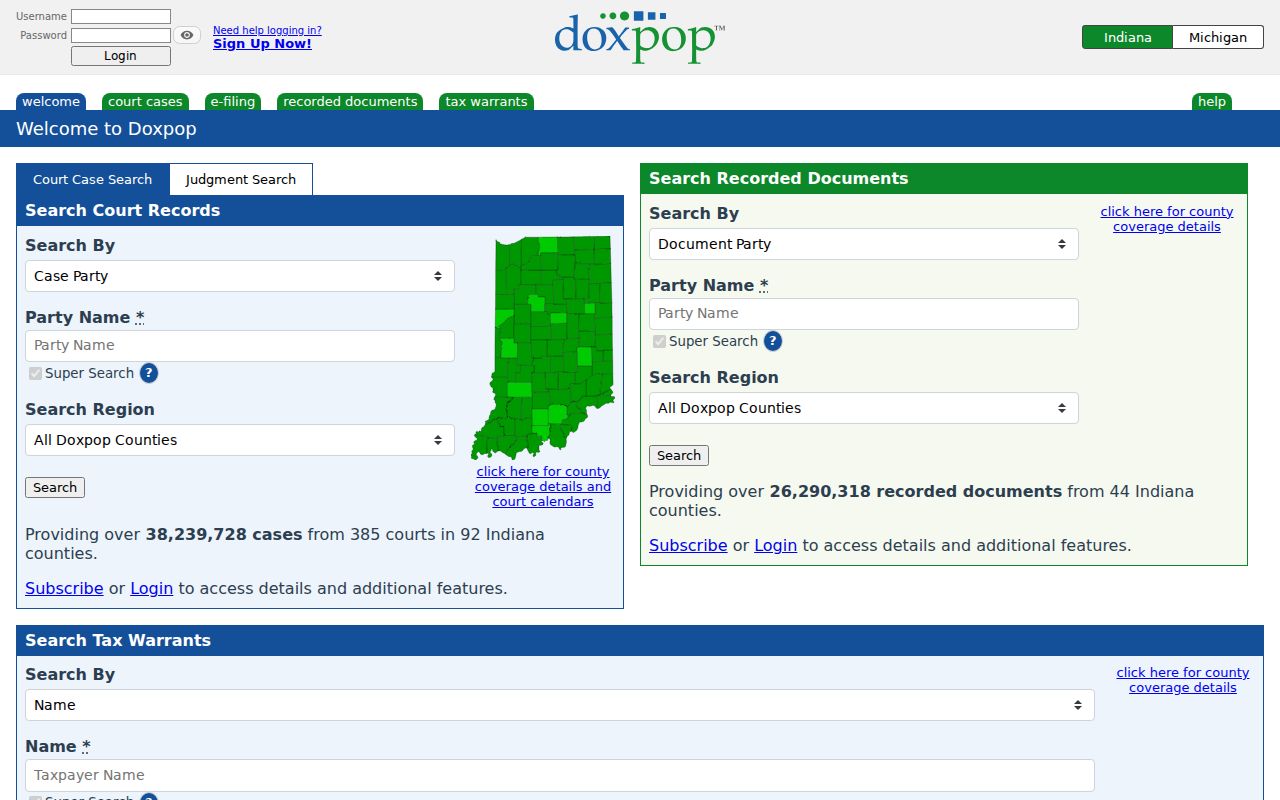
The modern service does not replace staff indexes, deed books, or microfilm for earlier deed research in Monroe County.
Search Monroe Deed Parties Carefully
Doxpop's dynamic shell supports party, county, document, and date research, though dropdown options may shift. Search names with and without punctuation. Reverse personal-name order and try initials too. Trust and LLC name forms can differ between the assessor and the deed index.
| Index clue | Best use | Check in the image |
|---|---|---|
| Grantor | Party giving an interest | Signature and legal description |
| Grantee | Party receiving an interest | Vesting name |
| Document type | Narrow deeds, mortgages, releases, or plats | Actual instrument terms |
| Recording date | Reduce a broad name set | Execution date may differ |
Keep the instrument number or book and page, recording date, deed type, and parcel description handy for the next link in the chain. Those details anchor each Monroe County deed search.
Walk Monroe's Grantor-Grantee Chain
A grantor gives an interest; a grantee receives it. Start from the latest known grantee, whether found through the assessor or the newest deed. Then make each grantor the subject of the next earlier search. Confirm the legal description. It must stay with the same tract as you walk the Monroe County chain.
- Find the assessment-roll owner and exact legal description.
- Search that name as grantee in Monroe County.
- Open the newest matching deed and record the grantor and reference.
- Search that grantor as an earlier grantee and repeat.
- Grantor
- The party giving a recorded interest.
- Grantee
- The party receiving that interest.
- Chain of title
- The linked sequence of recorded transfers.
- Book/page and instrument number
- Traditional and modern references used to retrieve a document.
Pre-1991 Monroe Deeds Stay Offline
The online cutoff is not where Monroe County land records begin. The Indiana State Library holds grantor and grantee indexes spanning 1811 through 1870, plus Monroe map and plat-book runs from 1856 through 2011. The Recorder still preserves archival microfilm and staff indexes.
Older-chain route. Ask Recorder staff to search party names, the legal description, deed books, and microfilm before moving to library and historical collections.
Monroe County formed in 1818 from Orange County, so the earliest deeds may sit in predecessor or federal-land records. No courthouse fire destroyed a defined record run. Check spelling variants, corrective deeds, probate transfers, and reverse indexes first.
Property Watch Flags New Filings
The free Doxpop Property Watch asks for State, County, and Full Name. Each subscription covers one name, and variants can be added separately. The alert flags a new filing. It is not proof that it touches the right Monroe County tract. The official Property Watch source carries the sign-up form itself.
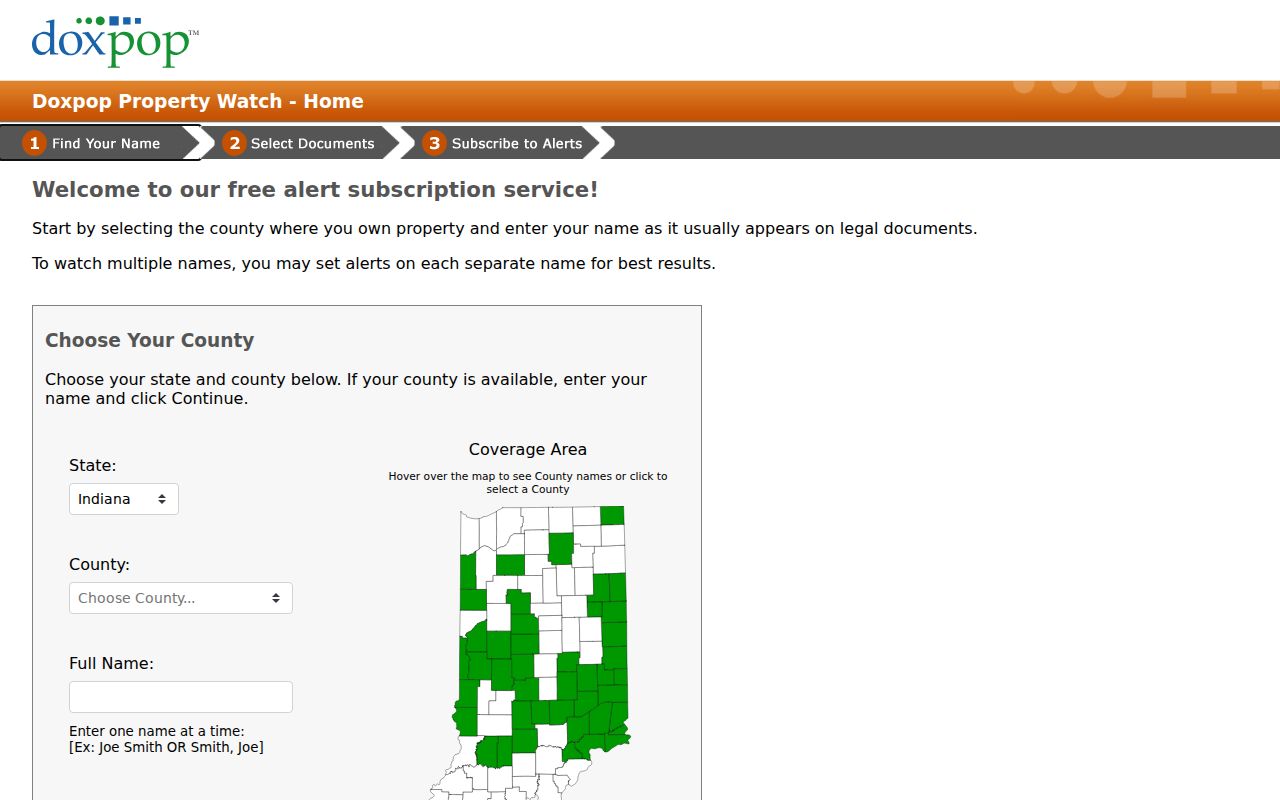
When an alert arrives, inspect the document type, parties, date, and legal description before drawing any conclusion.
Legal Descriptions Beat Street Labels
A modern address may not appear in an older deed. Copy the parcel legal description, subdivision, plat map, section, range, lot, and PIN straight from assessor data. Copy the section, range, lot, and PIN straight from assessor data. Lot-and-block text can survive street renaming and mailing changes. Recorded plats stay with the Recorder. The Surveyor links PLSS monument records and 1926 plat maps. When a deed uses part-lot or metes-and-bounds language, read its full image. Read any attached exhibit too. The Monroe County property search supplies the parcel clues that sharpen a deed-index query.
Order a Monroe County Deed Copy
The Recorder sits at 100 W Kirkwood Avenue, Room 122, Bloomington, Indiana 47404. Counter hours are weekdays from 8 a.m. to 4 p.m. Call 812-349-2520 or email recorder@co.monroe.in.us for an older or difficult deed copy. Copies cost $1 per page through 11 by 17 inches. Larger pages cost $5. Certification adds $5.
Recorded, not guaranteed. Monroe County deed records show what reached the public index; they are not a title opinion and cannot rule out unrecorded interests.
Fees for recording are separate from copy charges. The posted schedule sets $25 for deeds and most ordinary instruments. Mortgages cost $55, while large plats, transfers, and card payments carry special charges. Confirm the current schedule before filing.
A copy request lands best with details. Name the parties, the document type, the recording date or range, and the instrument number or book and page. Add the parcel's legal description if a party held more than one tract. Requests that arrive before 2 p.m. for certain older documents should surface in Doxpop by the next morning. The county does not promise full digitization of every early item. Keep the staff response with your notes.
Deed records rarely stand alone. Check any mortgage for a later satisfaction or release. A mechanic's lien may have a recorded release or a court enforcement case behind it. Easements and restrictive covenants can live inside the deed. They may also sit on the recorded plat or in a separate instrument. An association claim may be indexed under an association or management name instead of the street. Search both the property and the parties.
Court records can explain a conveyance that seems to jump. Indiana MyCase may show foreclosure, quiet-title, partition, probate, or lien-enforcement activity, within public-access limits. A court order may establish authority. A later Recorder filing locks the transfer or release into the land chain. A tax-sale notice is even less final. Confirm redemption, any court petition, and the actual tax deed before treating the list as a title change.
Older deed records pair well with maps. The official 1926 plat service can bridge a modern parcel to an old owner or tract label. The State Library's plat-book run from 1925 through 1941 helps the same way. MCPL's Indiana Room and the Monroe County History Center add directories, newspapers, and local-history context. Those sources help with names and dates. The deed book remains the primary conveyance record.